Learning theory & optimization
We study the mathematical principles behind machine learning, and use them to design algorithms that are efficient, reliable and easy to interpret.

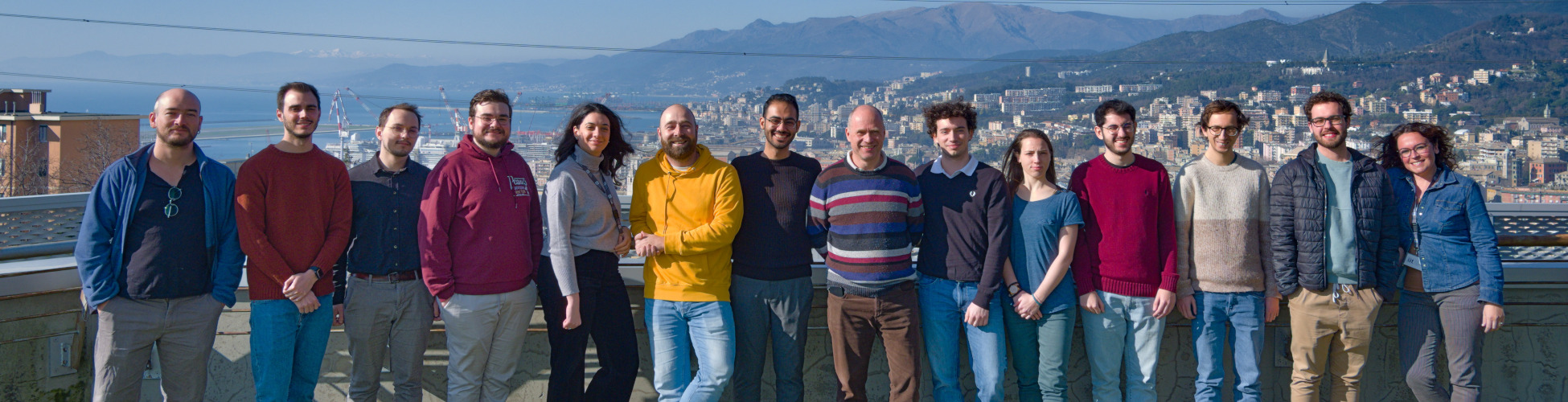
Foundational methods for reliable learning, scientific discovery and dynamical systems.
Our research spans machine learning theory and algorithms, drawing on mathematics and statistics, such as empirical processes and numerical optimization. The vast and varied data generated in real-world domains demands advanced machine learning techniques to infer structure and extract patterns. Developing efficient, reliable, and interpretable algorithms poses significant challenges for theoreticians, ranging from learning from time-dependent data, to advancing our understanding of transfer learning and reinforcement learning, and enhancing algorithms with inference capabilities such as uncertainty quantification.
Machine learning is transforming scientific discovery, achieving state-of-the-art results across science and engineering. Our work addresses fundamental challenges in scientific machine learning and has a broad multidisciplinary component with applications spanning computational chemistry, neuroscience, robotics, and, recently, climate modeling. A particularly fruitful research direction involves the interplay between machine learning, computational physics, and numerical simulations, addressing fundamental problems such as designing physics-informed algorithms to learn dynamical systems and discovering physical laws from complex datasets.
We study the mathematical principles behind machine learning, and use them to design algorithms that are efficient, reliable and easy to interpret.
We study how models can reuse what they have learned across different tasks, with a focus on reliable transfer learning and reinforcement learning.
We apply machine learning to scientific discovery, with work spanning chemistry, neuroscience, robotics and climate modelling.
We combine machine learning with physics to model how complex systems change over time, and to uncover the rules behind their behaviour.
Applications
From theoretical development to practical implementations, via collaborations with experts applying machine learning across disciplines.
Molecular dynamics for materials and catalysis

Michele Parrinello
Istituto Italiano di Tecnologia
Optical microscopy and spectroscopy for life science
Giuseppe Vicidomini
Istituto Italiano di Tecnologia
Legged robot hardware, locomotion and perception

Claudio Semini
Istituto Italiano di Tecnologia
Optimal control and motor intelligence for legged robots

Carlos Mastalli
Heriot-Watt University
 Visit lab
Massimiliano Pontil is recruiting several postdocs for LEO, which studies learning linear evolution operators from data, with applications to molecular dynamics and climate modelling. Researchers in data-driven dynamical systems, machine learning theory, or computational linear algebra are encouraged to apply; see the blog posts by Vladimir R. Kostić and Pietro Novelli and the careers page for how to apply.

Pietro Novelli, a researcher in CSML, has been awarded a European Research Council Starting Grant of €1.5 million over five years. The project, LINDY, will develop new AI algorithms that break down complex dynamical systems, such as climate evolution or protein behaviour, into simpler, linear building blocks. Novelli will carry out the research at IIT’s labs in Genoa and Pisa, building his own research group.
Massimiliano Pontil, principal investigator of CSML, has been awarded a European Research Council Advanced Grant for LEO. The project aims to build machine learning algorithms that are efficient, reliable and interpretable, and that can incorporate the laws of physics to predict the long-term behaviour of complex systems such as climate dynamics. Advanced Grants support researchers with an established track record of significant achievements over the past decade.

Research Scientist, Meta New York
PhD Student & Postdoctoral Researcher


Research Scientist, Microsoft Research Cambridge
PhD Student & Postdoctoral Researcher


Senior Research Scientist, Institute for Infocomm Research, A*STAR
Postdoctoral Researcher


Research Scientist, Amazon
PhD Student
Technical Coordinator, Trustworthy AI, Leonardo
Postdoctoral Researcher
Assistant Professor (Maître de conférences), Université de Lille
Postdoctoral Researcher


Current affiliation not yet verified
Postdoctoral Researcher

Postdoctoral Researcher, University of Oxford
PhD Student & Postdoctoral Researcher


Tenure-Track Assistant Professor, Aarhus University
PhD Student
Associate Professor, Télécom Saint-Etienne
Postdoctoral Researcher

Senior Researcher, Microsoft Research AI4Science
PhD Student

Postdoctoral Researcher, CREST, ENSAE
PhD Student

European Lighthouse of AI for Sustainability

Future AI Research

European Lighthouse on Secure and Safe AI

National Centre for HPC, Big Data and Quantum Computing